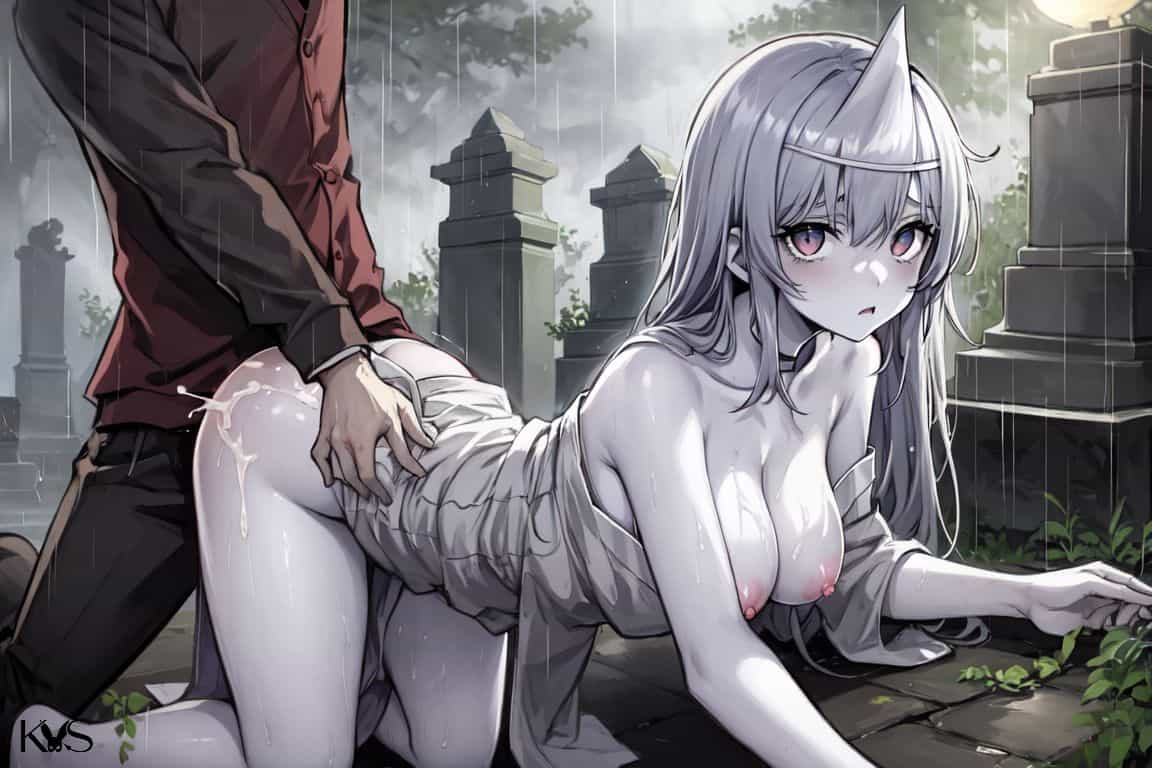
The lover you can feel but never quite see — no face, no weight, just presence and sensation. That is the central fantasy of spectrophilia, and for the people drawn to it, the invisible unknown is exactly the point.
This guide covers what spectrophilia is, where it comes from, the psychology behind it, how the fantasy manifests, and practical ways to explore it — solo or with a partner — safely and on your own terms.
What is spectrophilia?
Spectrophilia is sexual attraction to, or erotic fantasy involving, ghosts, spirits, or supernatural entities. The word fuses the Latin spectre (apparition) with the Greek philia (love or affinity) — a fitting label for desire aimed at something intangible. It belongs to the broader territory of Fantasy & Paranormal kinks, alongside tentacle fetish and monster fantasies, but spectrophilia has its own distinct character: the ghost is not monstrous so much as liminal — existing at the edge of perception, where uncertainty sharpens arousal.
For most people who identify with this kink, the attraction is not literally about believing in ghosts. It is about the idea: a lover who is present but unseeable, whose touch arrives without warning, who operates entirely outside the social scripts of ordinary sex. That ambiguity is what does the work.

The history: succubi, incubi, and centuries of ghostly desire

Spectrophilia is not a product of the internet. The eroticised ghost has roots stretching back to antiquity and running through nearly every major cultural tradition.
Succubi and incubi
The most elaborated historical versions are the succubus and the incubus of medieval European folklore. A succubus is a female spirit said to visit sleeping men, initiating sex while the victim is paralysed or half-dreaming. An incubus is the male counterpart, targeting sleeping women. Theologians treated these figures as demonic and dangerous — repeated encounters were thought to drain the victim's life force. Yet the accounts describing these spirits, from Augustine's City of God onward, are remarkably consistent in one detail: the experience is frightening and intensely pleasurable, often described as more vivid than waking sex.
Contemporary readers will recognise what these accounts are almost certainly describing: sleep paralysis — a hypnagogic state in which the body is temporarily immobile while the mind is semi-conscious. Sleep paralysis is well-documented as a trigger for felt presences and tactile hallucinations. The historical demon is, in many cases, the brain doing something physiologically ordinary while the culture reaches for the only explanatory frame available. The erotic charge attached to that state, however, is real and consistent across accounts spanning more than a thousand years.
Victorian spiritualism
In the nineteenth century, a mass fascination with the supernatural — séances, automatic writing, spirit photography — gave these ideas a new respectability and a new erotic undertone. The notion of spirit communication shaded easily into spirit intimacy. The Victorian ghost story is saturated with longing; the ghost lover became a literary archetype, reaching from Wuthering Heights to Yeats's supernatural encounters with his otherworldly muse.
Modern popular culture
Today the spectrophilic fantasy appears across film, fiction, and gaming — Ghost (1990), The Entity (1982), Hollow Man (2000), and a substantial body of supernatural romance and erotica. The archetype endures because it expresses something psychologically persistent: desire for connection with something that exists entirely beyond ordinary reach.
Why spectrophilia works: the psychology
Several overlapping mechanisms help explain why the ghost-lover fantasy lands so effectively for people drawn to it.
Ambiguity and anticipation. Not knowing exactly where, when, or how touch will arrive is a powerful arousal amplifier. The nervous system responds strongly to unpredictability — the same principle that makes a blindfold or a random vibrator pattern more intense than a predictable one. A presence you cannot see is unpredictability taken to its logical extreme.
Surrender without negotiation. One recurring theme in spectrophilia accounts — both reported sleep-state experiences and deliberate fantasy — is the feeling of having no choice. The ghost acts; the person receiving is simply open to whatever arrives. For many people, this is the appeal of CNC (consensual non-consent) more broadly: full surrender to sensation, the ego standing down. The ghost figure achieves this without requiring the social choreography of an actual negotiated scene.
The forbidden and the uncanny. Desire for something impossible or transgressive carries its own arousal charge. The ghost cannot be held accountable, cannot be judged, exists outside morality — which paradoxically makes the fantasy feel like a space free of judgment. Many people find that the further a fantasy strays from ordinary reality, the safer it feels to explore.
Sensory intensity. Accounts of sleep paralysis episodes involving felt presences consistently describe them as among the most physically vivid experiences the person has had. Whether encountered in a hypnagogic state or deliberately constructed through sensory play, the absence of visual confirmation seems to heighten every other sensation.

Types and variations
Spectrophilia does not mean one thing to everyone who finds it compelling. The fantasy shows up in several distinct modes:
Sleep-state encounters
Some people report what they experience as genuine sexual contact with an unseen presence during hypnagogic or hypnopompic states — the edges of sleep. Whether or not you believe these are literal encounters, the experiences are subjectively real and often intensely erotic. Many people who identify with spectrophilia came to the kink through exactly this kind of dream or half-dream episode.
Deliberate solo fantasy
The most common mode: using imagination, erotica, or audio to construct a ghost-lover encounter in the mind. The lack of a visible body is the feature, not a bug — it allows the fantasy figure to be whatever the person needs in the moment.
Partner roleplay
A partner takes on the role of the invisible or partially invisible lover — using technique (darkness, a blindfold on the receiving partner, deliberate stillness, breath and fingertips only) to create the impression of ghostly presence. This kind of roleplay can overlap with sensory deprivation, which amplifies tactile sensitivity by removing visual cues.
Media-mediated fantasy
Films, audiobooks, erotic ghost fiction, and ASMR recordings are all common vehicles. The atmospheric distance of fiction allows exploration without the negotiation of live roleplay — useful for people who want to understand the kink before introducing a partner.
Signs spectrophilia might be part of your erotic landscape
- You have had unusually vivid or erotic dreams involving a presence you could not see but could feel distinctly.
- The idea of an unseen lover — touch without a visible body — is consistently more arousing to you than explicit visual imagery.
- Supernatural or horror-adjacent fiction draws you in partly for erotic reasons you find hard to explain.
- Blindfolds or darkness do not diminish arousal for you — they increase it.
- You feel a pull toward experiences of complete surrender that bypass ordinary social negotiation.
If several of those resonate, the Kink Quiz can help you map how spectrophilia sits alongside your other interests.
How to explore spectrophilia
Solo exploration
- Create an immersive environment. Low light or darkness, ambient sound (rain, wind, instrumental music, or dedicated supernatural soundscapes), and scent (sandalwood, frankincense, beeswax candles) all prime the mind for an atmospheric encounter. Sensation enters a different register when the visual channel is dimmed.
- Use guided audio or erotica. First-person narration in the dark is remarkably effective — the voice of someone describing an encounter you cannot see maps cleanly onto the ghost-lover fantasy. Erotic ghost fiction, ASMR-style recordings, and audio erotica platforms all offer material in this register.
- Explore hypnagogic states deliberately. The edge of sleep — drifting without fully going under — is where the felt-presence experience tends to arise naturally. Going to bed with the fantasy active in mind, allowing yourself to hover in that liminal state, is the closest analogue to the experiences people describe.
- Use a mirror. Some people find that watching themselves in low light while imagining an unseen partner dramatically intensifies the sense of presence. The mirror reflects your reactions to something that is not visibly there.
Partner exploration
- Name it outside the bedroom first. "I have this fantasy about an invisible or ghostly lover — can I describe it?" is a low-stakes, high-clarity opener. The conversation itself often functions as foreplay.
- Build atmosphere together. Total darkness, or a blindfold on the receiving partner, is the simplest and most effective technical approach. When you cannot see your partner, you are left with breath, scent, weight, and touch — exactly the sensation profile of the fantasy.
- Move with deliberate uncertainty. The spectrophilic aesthetic is not rapid or predictable. Slow arrivals, long pauses, a single fingertip tracing a path and then disappearing — these recreate the felt-presence quality better than ordinary touch.
- Layer in sound. Whispering close to the ear, barely audible, is extraordinarily effective in darkness. The voice without a visible face crosses toward the uncanny in exactly the right way.
- Agree on a safeword. Even in "soft" atmospheric play, one partner is deliberately operating in the dark and the other is deliberately withholding their presence. Check in verbally before beginning — "if anything feels wrong, say [word] and we stop immediately" — and honour it without hesitation. See our guide to aftercare for how to close the experience.
- Try remote-controlled sensation toys. Vibrators operated by a partner without announcing the timing create genuine unpredictability, one of the core drivers of the kink. The sensation arrives; the source remains invisible.
Is spectrophilia normal?
Yes. Paranormal and supernatural fantasy is among the most common fantasy categories reported across large-scale surveys — the Kinsey Institute has documented the breadth of fantasy variation extensively, consistently finding that unusual or impossible scenarios rank among the most frequently reported. Spectrophilia sits comfortably in that company.
What matters is not the content of a fantasy but how it functions: does it add to your pleasure and sense of self, does it remain clearly in the realm of imagination or consensual play, and does it leave you and any partners feeling good? If the answers are yes, the kink is doing what kinks are supposed to do.
No certification is required to explore this. Start where you are — solo fantasy is a completely legitimate destination in itself, not a stepping-stone to anything else.
The ghost lover is, at its core, a fantasy about pure sensation stripped of all the visual and social information we usually rely on. When you remove the face, the body, the legible presence — what's left is just the feeling of being touched by something that chose you. That is a remarkably potent erotic idea, and it has been for a very long time.
— Samuel Davis
Curious where spectrophilia sits alongside the rest of your erotic landscape? Take the 2-minute Kink Quiz →